


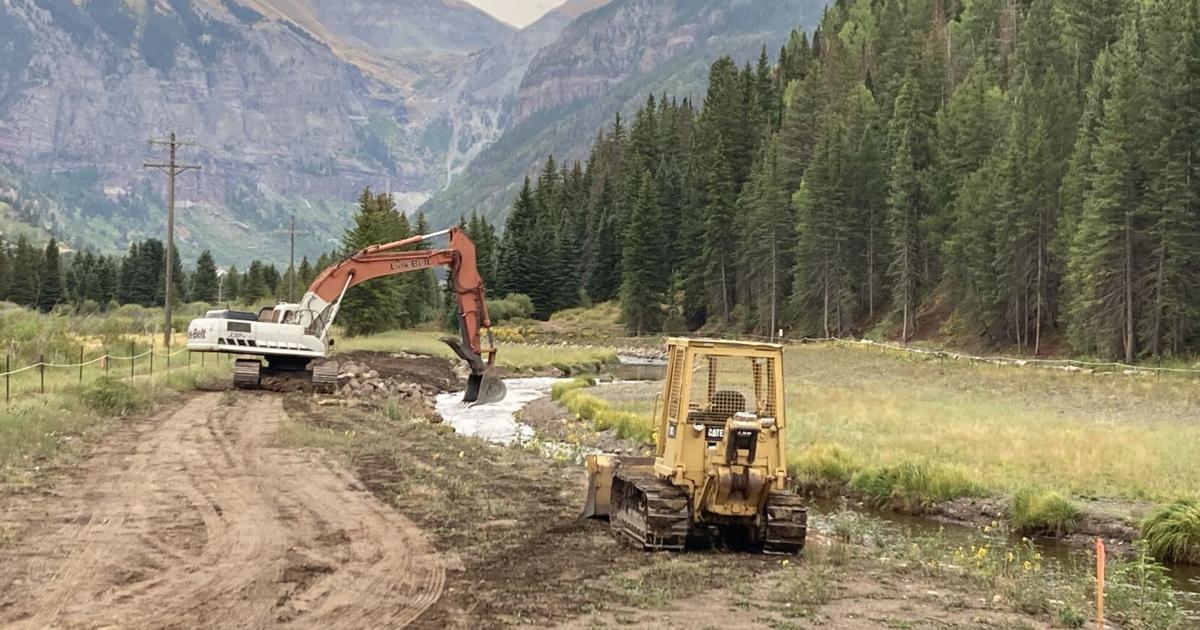
If you’ve noticed some heavy equipment on the Valley Floor, out beside the Boomerang Road Bridge, it’s because restoration work on the U.S. Forest Service-managed section known as the Wedge is underway.
The project includes river and revegetation work and is taking place at a tailings removal site upstream and downstream from the bridge.
The project, which is expected to continue into November, is a collaboration between Trout Unlimited (TU) and the Grand Mesa, Uncompahgre and Gunnison National Forests’ Norwood Ranger District (GMUG).
Tanner Banks, program manager with TU, is overseeing the work on the Wedge, with restoration efforts that fall outside federal land boundaries set for completion by the Town of Telluride.
The TU and GMUG portion of the planned work includes stabilization of eroding riverbanks, revegetation along the river as well as in adjacent areas, and a small amount of river realignment.
According to a statement from Daniel Malta, public affairs officer with GMUG, the work aims to address degradation to the area that occurred between 2020 and 2022.
At that time, the Environmental Protection Agency (EPA) carried out a removal action at the site to “address approximately 50,000 cubic yards of mine tailings contaminated with arsenic and lead,” Malta said.
As the EPA removed the tailings from one location, it took clean soil from an area alongside the river to fill in the excavation site.
Following that work, a muddy pond formed in the area beside the river.
Banks explained that the area where the pond formed is known as a “soil borrow,” a site where clean soil has been extracted to be used as fill at another location.
“Because of the amount of material that the EPA was required to haul off-site, they ended up expanding that borrow tremendously,” he said. “What was left behind ended up lower than the channel of the river in some places and it attracted both surface water and groundwater expression. That is why that pond formed.”
Banks continued, “We have determined that, to best restore that area and reduce the ponding going on there, we are going to build the channel through that former EPA borrow area.”
Subsequent work will turn the current channel, which Banks described as “intermittent at this point,” into a wetland, highwater flow area.
Banks referenced ponds formed by beavers elsewhere on the Valley Floor and remarked that, unlike the beavers, the ponding created by the EPA action was “not a natural progression, so we want to get in there and address it.”
“We will probably see natural ponding in the future when beavers establish into this site, but at present we need to revegetate the site to allow water to move freely across it without causing a great deal of erosion,” Banks said.
The Valley Floor Trail, which traverses the construction area, is scheduled to remain open but may be re-routed at times.
“We will intermittently be closing trail segments,” Banks said, “but we are planning to maintain access from one side of the site to the other throughout the project.”
The portion of the San Miguel River that flows through the site may be closed during portions of the project.
Closure signs and fencing will be posted on the re-routed trails and the river.
Of the importance of the work, Banks said, “I think that the Valley Floor is a unique case in that there are few places, at least in the intermountain West, in developed areas, where you have undeveloped wetlands and riparian stream corridors.”
He continued, “There is interest and value in maintaining these habitats and connectivity.”
Banks noted that it might be easy to focus on the removal of tailings from the Valley Floor, but just as important are “actual restoration steps.”
“They are some of the most important parts of the program,” he said. “Our concern right now is that if we don’t address the habitat degradation that has taken place since the EPA was there, we will just continue to see degradation and drying out of these areas.”
Banks continued, “We want to re-wet that valley margin out there and try to encourage all these native species to persist, which will then support the elk, migrating birds and support beavers and essentially restore functions.”
Banks added that the ultimate goal is to “set up a trajectory where we can allow this site to move through a more natural succession where the plants and structures that we build drive changes over time.”
Banks also gave a figurative pat on the back to the organizers and attendees of Trout-a-palooza, the Gunnison Gorge Anglers’ fundraiser that takes place each summer in Telluride.
Roughly $20,000 raised from the event was used to match with state and federal grants that in turn are funding the project.
“This is all very much related to the money we raised from that fundraiser,” he said.
link