A Study in Color Theory | Daily Gate City – Keokuk, Iowa
The Keokuk Art Center is a proud sponsor of the arts in the Tri-State area, having a long-standing tradition of holding monthly art exhibits at the Round Room Galleries at Keokuk Public Library.
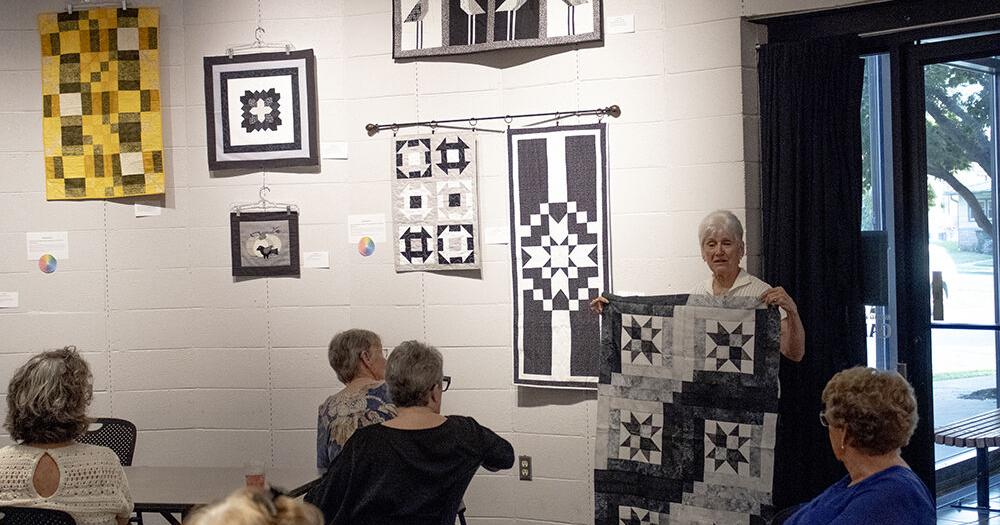
For the month of October, the tradition continues as the Art Center, along with Dennis and Linda Apple, sponsor the Tri State Quilt Guild’s “A Study in Color Theory.”
To begin the exhibition, an Artists’ Reception was held Friday, Oct. 3 from 5-7 p.m, including a Special Presentation in the middle at 6 p.m.
Each piece was quilt-work, crafted by members of the Tri State Quilt Guild, adhered to themes studied during Guild meetings. A text the group used, “A Fiber Artist’s Guide to Color & Design” by Heather Thomas, aided the learning process as they discovered the finer details of color theory through seven workshops, each focused on an aspect of color theory. Showcased pieces aligned with color theory tidbits discovered in each workshop.
In the Special Presentation at 6 p.m., Linda Apple and Rita Hickey of the Guild spoke about these along with Joyce Taylor, showing off guild-created work corresponding to each workshop theme before the vast audience. Barbara Wilson, also with the Guild, spoke about her 12 visits sharing knowledge and pushing people out of their comfort zone.
Wilson, alumnus of Weber State University, formerly worked with Utah Tayloring as a designer, then met a colorist. Wilson, awestruck with appreciation, noted the colorist was supremely generous with her time. Wilson also worked as a color consultant for major retailers, revealing it’s no surprise that people see certain colors each season in marketing trends. “It’s not an accident” she said, revealing color matches are carefully planned. Speaking of Paris seminars held by industry leader Pantone, often seen as “the standard” for everything color, Wilson revealed that this year’s color is “mocha,” a peachy brown.
The first workshop, “Discovering Value and Texture Through Neutrals and Playing with Balance,” covered basics, exploring black, gray and white. While those three colors are the “true neutrals,” often pale, brownish colors like tan and taupe are included in neutral schemes. Balance was observed through size and proportion in completed designs. The first project was to “create something interesting using value and texture without color.”
Workshop two, “Monochromatic Quilts: Exploring the Use of Color Scale and Contrast,” covered monochromatics, meaning one color alone, along with its various tints, tones and shades. Tint means the addition of white; tone, the addition of grey; and shade, the addition of black were used with contrast, meaning light vs dark and cool vs warm; as well as scale, to balance visual interest. The project used monochromatic elements “while working toward unity.”
Workshop three was “Managing Complementary Color Schemes.” When looking at a color wheel, complementary colors lay directly across from each other. Pulling for the eye’s attention, when both are used equally, there’s no place for the eye to “rest.” The challenge was to tale a high contrast color and get it to interact well in a design. For example, orange is a dominating color on its own, so in one of Rita Hickey’s pieces, she used 40 orange and 60 blue squares to maintain equilibrium.
Workshop four, “Complex Complements,” referred to what are called double, double-split, split, and analogous complements. It’s a complicated so without getting too far into the woods, suffice it to say that complex complements created even bigger challenges for the artists, but their final results were stunning.
In workshop five, “Creating with Melodious, Analogous Color Scheme,” participants learned analogous means a primary color in common. They learned that a three-color scheme usually favors one temperature. The project was to incorporate three to seven adjacent colors.
Workshop six, “The Harmonious, Triadic Color Scheme” explored triads: three equidistant colors. Favorable visual choices often used one color in a prominent role. The challenge was to create a triad piece with bold colors not overpowering others.
The final workshop, “Tetrads: The Multi-Faceted Four-Color Scheme” similar to triads, instead focused on using four equidistant colors. All design principles learned in the courses were to be used to let the colors interact pleasantly in finished projects.
There was also time for a short question and answer session.
Audience members, eager to know the secrets to quilting success, wanted to know if the quilters did everything by machine. This was not the case, especially when it came to appliqué.
Others wanted to know where fabric and patterns were obtained. Diverse sources ranged from big-box retailers to smaller niche marketers. Some confided starting from a personal fabric stash gathered over the years. It was also discovered that they did not stick to just one fabric type; apart from cotton sometimes wool was used, giving variety and depth in texture.
The Guild meets the second Saturday of each month at 10:00 — 12:00 p.m., through Keokuk Art Center (lower lever of the Keokuk Library) and still offers Wednesday color classes. Contact any Guild member to learn more.
link