Our Changing Planet’s Liz Bonnin and Ade Adepitan discuss Restoring Our Rivers in a brand new series
Our Changing Planet is an ambitious natural history series exploring the issues facing the planet’s most threatened ecosystems and meeting the scientists and local conservationists fighting to make a difference.
This year, we follow efforts to protect and revive our dying rivers. Two ambitious river restoration projects are aiming to bring life back to the Klamath in northern California and the Seine in Paris, France.
Globally, 2 billion people rely on rivers for drinking water and a quarter of the food we eat depends on them. But our rivers are in deep trouble – pollution, water extraction and huge dams blocking their flow have all taken their toll on freshwater species.
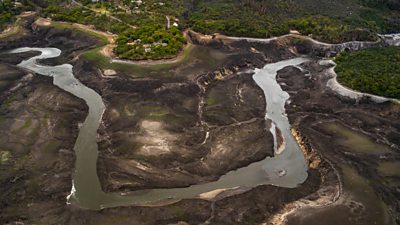
Liz Bonnin returns to northern California, where the largest dam removal project in US history is aiming to resuscitate the river Klamath. Historically, it had one of the largest salmon runs on the West Coast but from the early 1900s a series of giant dams were built to provide hydroelectric power. These dams blocked salmon from reaching their spawning grounds, stopped nutrients reaching downstream and toxic blue-green algae flourished in the warm reservoir. The effects were disastrous – the whole ecosystem was damaged and numbers of Chinook salmon fell by more than 90%.
This had a profound impact on members of the local indigenous tribes, such as the Yurok and The Karuk who have lived alongside the 254 miles of the Klamath for thousands of years. With so few salmon in the river, fishing has been banned and a source of free, healthy protein is no longer available. For members of the tribes, the salmon isn’t only a source of sustenance, it has huge cultural significance and it’s demise has been a devastating blow.
Liz meets Frankie Myers, Vice Chair of the Yurok tribe who describes how the salmon are vital for the whole ecosystem, feeding other wildlife of the river – bringing back a healthy salmon population is the key to restoring the Klamath.
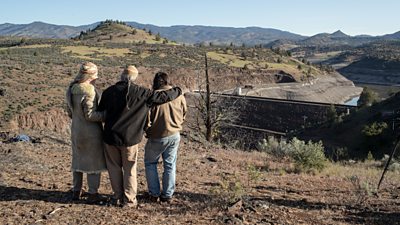
Now, after decades of campaigning, the dams are being demolished. Liz joins Mark Bransom, CEO of the Klamath River Renewal Corporation, the organisation tasked with getting rid of the dams and reviving the river. They witness the largest of the dams, Irongate, being torn down with diggers and dumper trucks – the aim is remove all trace of the dam within 4 months, in time for the salmon returning to breed upstream in the Autumn.
A few miles upstream, conservationist Dr. M Sanjayan is onsite when another dam, Copco 1, begins to be blasted apart with dynamite. Sanjayan has known this landscape for 30 years but now it’s about to be completely transformed, the vast reservoir the dam created has been drained and it’s demolition day – a nail-biting time for all involved.
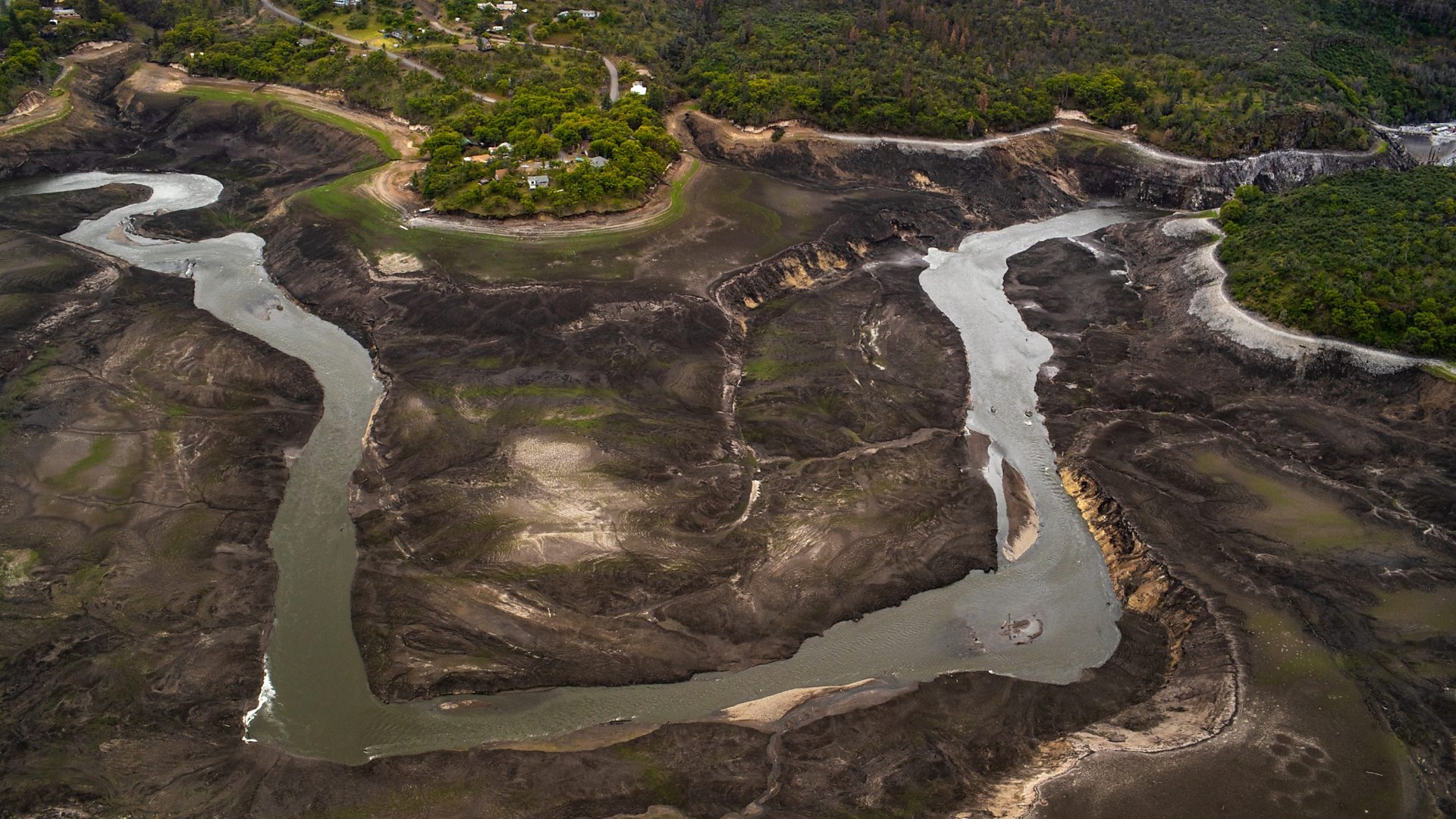
The empty reservoirs behind the dams are now vast, muddy wastelands that need to be turned into vibrant riverside habitat. Liz gets hands on with the revegetation crew who are working fast to to plant native species that will stabilise the soil and stop it washing into the river. Senior ecologist Joshua Chenoweth, describes how the team have collected seeds from 98 species of plants along the river over the past few years and grown them in farms to provide billions of seeds than can now be sown by hand or, where the terrain is too treacherous, by helicopter. But some species grow better if planted as seedlings and Liz helps the team planting milkweed, a vital food plant for endangered monarch butterflies.
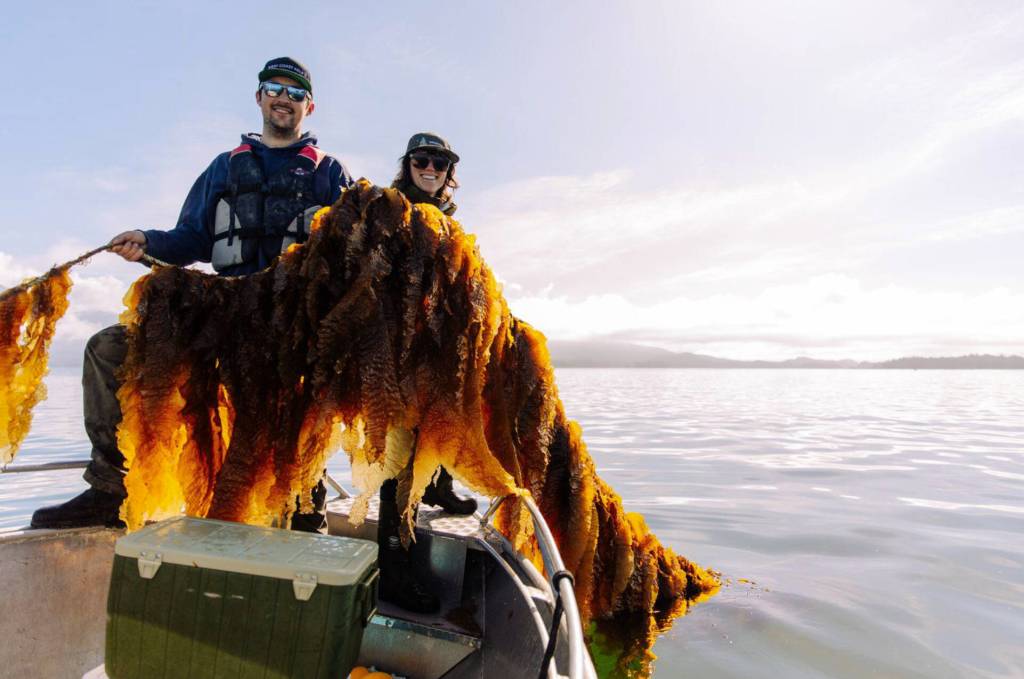
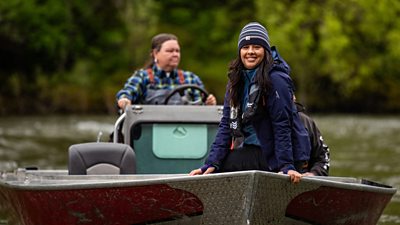
Liz also gets on the water with the fisheries team to take a census of the river using a special floating trap that catches juvenile salmon on the way out to the Pacific Ocean. The team measure and assess the fish before returning them to the river to continue their journey. By monitoring the health and growth rate of the fish the team can keep track of the salmon’s recovery and work out how to intervene if necessary.
The vast landscape is changing fast, so to get a bird’s-eye view Liz takes to the air with engineer and Yurok tribal member, Felicity Cross. Using a plane equipped with a hi-tech laser system, Felicity maps and monitors how the river is evolving and carving its way back to its old course.
There’s one more thing that should be in the skies – the Californian condor, the largest land bird in North America. Historically, these huge scavengers would have feasted on the spawning salmon but very nearly went extinct. Now, the Yurok tribe is re-introducing these magnificent birds at a top-secret location, rebuilding the link between the river and the surrounding ecosystem.
In France, journalist and Paralympian Ade Adepitan investigates the colossal detox of Paris’ iconic river Seine. Urban rivers are amongst the most polluted on Earth and Ade heads underground to see the source of the problem – Paris’ ageing sewer system. For decades, raw sewage flowed into the Seine, killing off aquatic wildlife and with levels of E. coli over 500 times the safe limit no-one would want to swim in it.
When Paris won the bid to hold the 2024 Olympic and Paralympic Games, the mayor pledged to clean up the river and make it safe to swim in. A mega-engineering project is underway to stop human waste ending up in the Seine. It’s not only elite Olympians that will benefit – ahead of the Olympics hundreds of open water swimmers are taking part in a 5km race. Inspired by these amateur enthusiasts, Ade takes the plunge and goes for a swim himself, despite the water being a chilly 13 degrees.
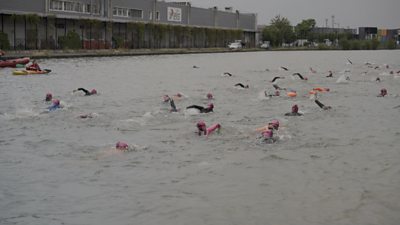
Scientist Fabien Esculier is spearheading a solution that that could reduce the pressure on sewer systems and make use of our waste. Fabien takes Ade to the European Space Agency to see some very special toilets designed to separate and collect urine so that it can be used as agricultural fertiliser. Fabien estimates that if all the urine of Paris could be collected it would be enough to grow 25 million baguettes a day!
Wildlife should thrive in a cleaner Seine too – at one point the river was so polluted it was declared biologically dead, so Ade finds out if the clean-up efforts have paid off. He joins fish biologist and keen angler Bill Francois, who is head of the local angling association that oversees the health of the river. They’re hoping to hook the largest freshwater fish in Europe, a giant Wels catfish, at the top of the food chain and a good indicator of a healthy river. A few decades ago, there were just 3 species of fish in Paris’ Seine, now there are over 40.
These pioneering projects offer solutions and hope for other rivers around the world. If the Seine, surrounded by a busy capital city, and the Klamath, devastated by a century of damming can both be brought back to life then there’s no reason it can’t be done elsewhere.
Our Changing Planet is a BBC Studios Natural History Unit Production for BBC and PBS.
VC
Interview with EP Rosemary Edwards
What do you believe is so captivating about Our Changing Planet?
I think it is captivating because every story we tell is a story of hope in an uncertain world. We face a pivotal moment in the Earth’s history. The future of our precious ecosystems hangs in the balance. But there are thousands of people out there making a difference – Over the course of the past 4 years we have charted the amazing efforts of local eyewitnesses and conservation heroes at many vulnerable locations from the Arctic and the Amazon to California, Europe and in Asia. And it is when local eye witnesses, conservationists and scientists come together that great things happen.
Take this season – the long-term efforts of the First Nation people in California are literally restoring a whole ecosystem by restring their lost river.
So each season we are showing that things are irreversible when there is a will and when people come together in a united conservation effort.
What was the inspiration behind making Our Changing Planet: Restoring Our Rivers?
We had been visiting California for three years and had met the Frist Nation Yurok tribe and heard of their campaigning to remove four dams on the Klamath River there.
When they won a landmark victory and had permission to remove those dams to let the river run freely again, we knew we had to go and document history in the making. As freshwater becomes an ever-more precious resource for people and wildlife, this river restoration could for a template for other projects globally.
The Yurok are hoping that by allowing the water to flow freely for the first time in a century the river will see the return of the traditional salmon run – bringing life back to the whole area – as the return of the salmon will attract other wildlife which historically relied on the salmon to survive.
How does the production choose the location to base the series on?
In season one we chose locations that represented some of the biggest threats to our planet’s ecosystems – so melting ice, heating land masses and drought, polluted and struggling river systems and deforestation and urbanisation. Each location told the story of the courageous local efforts trying to reverse those challenges – offering solutions that could inspire other communities facing the same battles.
Since season one we have tried to return to one of those locations to chart the changes and measure the successes of each inspirational project. So, for example – this is the third time we have returned to California.
What are the most important messages you wanted to get across to viewers this series?
I think hope and the realisation that great things happen when people work together. Rivers are vital for survival for both people and wildlife but they are suffering – globally.
River species are declining twice as fast as land and marine species – river wildlife has declined over 84% since 1970.
But through both the river stories we tell this year – there is hope. These are scalable, transferable initiatives and that offers exciting prospects.
I remember watching presenter Liz Bonnin walk across a giant earth dam in California. It is huge but it was being removed digger load by digger load. Seeing that in the programme was humbling as you realise what the team over there is doing to restore the natural habitat.
In Paris, Ade Adepitan learned about cutting edge science tackling river pollution – even swimming in the newly restored Seine. That was something that had been banned since 1923 because the river quality was so poor. I think if it can happen in Paris on the Seine – it can inspire change across many other threatened river systems.
Interview with presenter Liz Bonnin
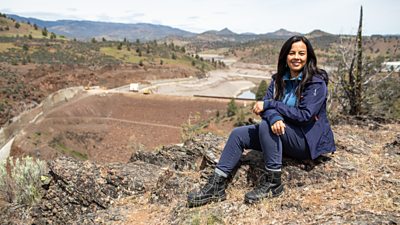
Tell us about the locations you filmed in for this series?
We filmed in Southern Oregon and Northern California, along the Klamath River, to document the historic removal of four hydroelectric dams, that for a hundred years had obstructed the river’s flow, impeding countless natural riverine processes, as well as blocking salmon and trout from accessing hundreds of kilometres of spawning habitat.
We were there to witness the results of decades of campaigning by Indigenous communities to remove the dams and restore the river’s health, and the Yurok Tribe showed us just what had been at stake, and how much work was in store to recover this precious ecosystem now that the dams were being dismantled. They were incredibly generous with their time, helping our team to tell the story of just how important it was for people and nature that the river was able to flow again. It was also heartening to see the collaboration taking place between the Tribe and the Klamath River Removal Corporation, who were responsible for the mammoth task of removing the dams. Both communities worked together and understood implicitly why this was crucial, their passion and determination was incredibly inspiring.
Were there any standout or memorable sequences for you whilst filming?
It was incredible to spend time in the company of the teams that were charged with ‘re-vegetation’ – the painstaking task of planting, by hand, the seeds and shoots of native plants on the huge expanse of newly exposed, muddy riverbed. It had taken years of planning, the production of thousands of seeds from ones that had first been collected in the region, and now, we were on our knees placing each shoot into soft earth, that hadn’t been exposed in a hundred years. Speaking to the Tribe, it was clear just how momentous this was for them, to have their river flowing, and, as one of the Yurok Tribe members said, singing again.
The Klamath River is the source of life, food, traditions and spirituality to the Yurok – it is their kin. With this kind of intimate, deeply connected relationship with nature, their goal is to never harm the river, to never take too much from it, and always give back, by taking care of it.
Did you learn anything new about the ecological issues you explored?
I definitely underestimated the impact that the dams had on the Klamath River and the wider environment. Not only did they block the crucial migration of salmon and trout, which is already incredibly problematic because these fish and their offspring provide the river with lots of marine-derived nutrients, crucial fertiliser for the riverbanks and surrounding forests, and support the complex food web here, but with millions of cubic meters of water locked away and essentially stagnant for a hundred years, toxic algae built up, the water became unsafe to drink or swim in, and thousands of species suffocated and died off.
Without flowing water and the silt it carried, algae, worms and parasite weren’t scoured off the rocks, and the silt also couldn’t be deposited on the riverbanks, like in a free-flowing river, to prevent erosion -the list goes on… When we drive past such huge, dramatic reservoirs, I don’t think many of us have any idea of the damage taking place beneath the surface. It’s also staggering just how much the surrounding vegetation is affected – how so many native species die off here too, when the lifeblood of the entire ecosystem is not allowed to flow and function as it should. Everything is so much more interconnected and interdependent than we might first imagine.
Tell us about the people you met and describe your experience working with scientists and experts in the field?
It was real privilege to spend time in the company of the Yurok Tribe, many of whom have studied our Western Science to be able to get a seat at the table of conservation planning in the region. But their own indigenous knowledge is so crucial for us to be able to understand the true extent of interconnections in nature and how to approach conservation more holistically. What they have contributed to this project, with this knowledge, is priceless. Felicity Cross trained as an engineer and collects Lidar data of the newly freed river to better understand how to support its recovery, and I witnessed her incredible passion and commitment as we collected data together. Barry McCovey Jnr trained as a biologist and works to monitor and protect the Klamath’s salmon populations; the way he spoke of his tribe’s future now that the river is free again brought a tear to my eye. Jamie Holt and Gill Meyers both work with the Tribal Fisheries Progamme further down river from the dams, to support the various salmon and trout species, and we had a joyful time together on the river collecting and tagging fish for future monitoring. All of them were so generous with their time with us, and their love for the Klamath was infectious. I learned so much from them, as well as from Yurok Tribe vice-chair Frankie Myers and Mark Bransom, the CEO of The Klamath River Renewal Project. I left feeling bolstered by all these extraordinary humans, carrying out extremely challenging work to protect our planet as we go about our daily lives.
What do you believe is so fascinating about Our Changing Planet?
I think Our Changing Planet is a much-needed platform for showcasing the tremendous work going on around the world to safeguard nature and our future. So many exceptional humans are innovating and collaborating to that end, and I don’t think we hear about them enough! In these incredibly challenging times, it is a real joy for me to be able to share their stories, and what is possible, when we are at our best.
Interview with presenter Ade Adepitan
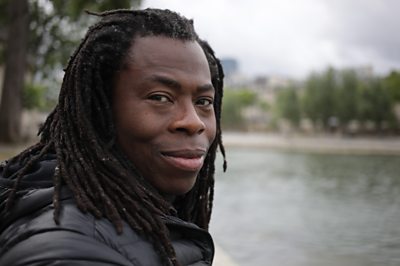
What captivated you the most about being involved in this project?
What happens to our rivers and waterways will affect all of us, so the clean-up of the Seine is a project we can all connect with as most of us either live on or near a river. I was also excited to understand the impact a dirty river in a major city can have on its inhabitants and learn how much that changes when the river is brought back to life.
Were there any highlights or memorable sequences for you whilst filming?
I’m not a strong swimmer and I’ve never swam in an inner-city river before, so getting the chance to swim in the Seine and living to tell the tale was super exciting.
What was it like filming in the river Seine in Paris?
Paris is an iconic city, it’s always special filming there even more so in the lead up to the Paralympic and Olympic Games, knowing I’d be pretty much swimming in the same river Paralympic and Olympic athletes would be swimming in felt very special.
Did you learn anything new about the ecological issues you explored?
I learnt about the importance of city wildlife catfish and how important they’ve become to inner city ecosystems.
link