Restoring Parliament Hill’s heritage Queen’s Gates
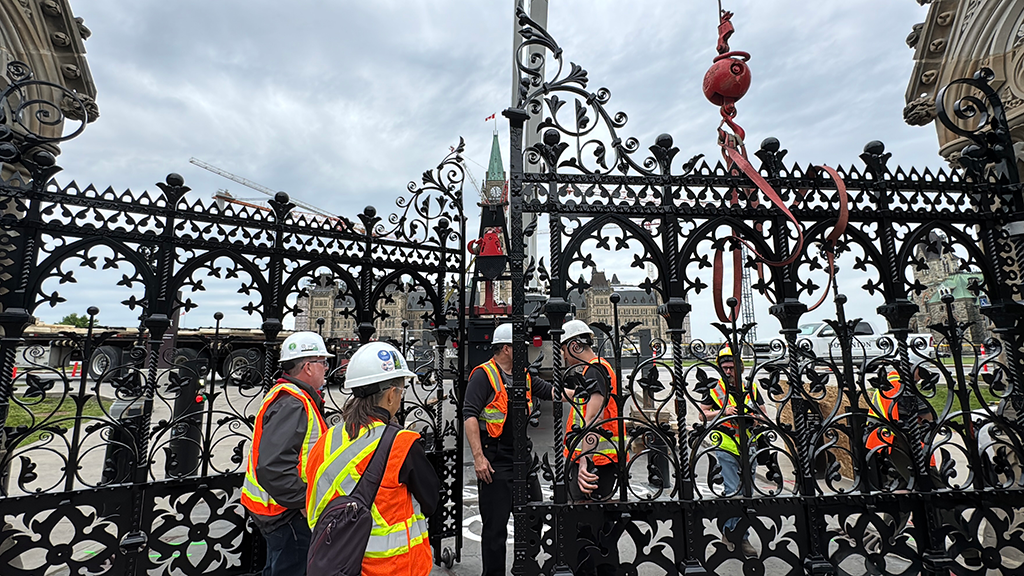
A pair of iron gates on Wellington Street have served as the main ceremonial entrance to the Parliament Hill grounds for nearly 150 years.
Grand and ornate, imposing yet intricate, they’re known as the Queen’s Gates in honour of Queen Victoria, the long-reigning 19th-century British monarch who wore the crown when Canada became a nation.
Now they’re ready for the next 150 years after restoration.
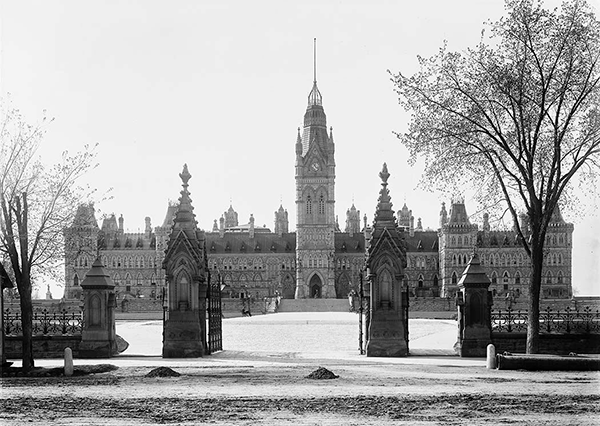
“They have high cultural, heritage and architectural significance, and they’re works of art,” said Rebecca Casagrande, a conservation materials specialist with Public Services and Procurement Canada (PSPC).
“It’s important for PSPC to conserve these gates for generations to come.”
Designed in the High Victorian Gothic style by Canadian architect Frederick J. Alexander, manufactured in Montréal by H.R. Ives and Company in 1872 and installed in 1876, the Queen’s Gates predate the Hill’s most recognizable landmarks: Centre Block, the Peace Tower and the Centennial Flame.
Their longevity can be attributed to the materials from which they were forged: a mix of cast iron and high-quality, wrought iron from the United Kingdom.
“At the time, they were considered the best example of iron working in North America,” said Casagrande, who provided technical advice and guidance to the restoration project team.
Removal
The main central gates and the two smaller pedestrian gates on either side were removed from the Wellington Street wall in March 2024.
Because of their substantial weight — the main gates alone weigh the equivalent of an adult black rhinoceros — a mobile crane was brought in to do the lifting and loading.
Once secured onto trucks, the gates were transported to Dominion Restoration’s workshop on Montréal’s South Shore. The Canadian company, which specializes in heritage material restoration, won the competition to restore them.
Restoration
While each gate appears to be one big fixture, each leaf is actually made up of approximately 300 separate components. Each rail, each plate, each decorative element — including leaves, flowers and scrolls — is its own work of art.
Mark Jones, president of Dominion Restoration, said his team came across a surprise that confirmed the superior quality of the wrought iron they were handling.

“We found a manufacturer’s stamp that said ‘best boiler,’ so we know the material selection for this was really top-notch,” Jones said.
“When we talk about the grade of wrought iron, boiler or boat chain were the best grades you could get because they were tested. Back in the day, that meant the material was suitable for building a boiler or pressure vessel, and strong enough to hold a boat.”
Over the course of the 20th century, the commercial production of wrought iron declined and ceased altogether with the advent of mild steel, which was cheaper and easier to mass-produce. Jones sourced recycled, genuine wrought iron from one of the world’s only remaining suppliers.
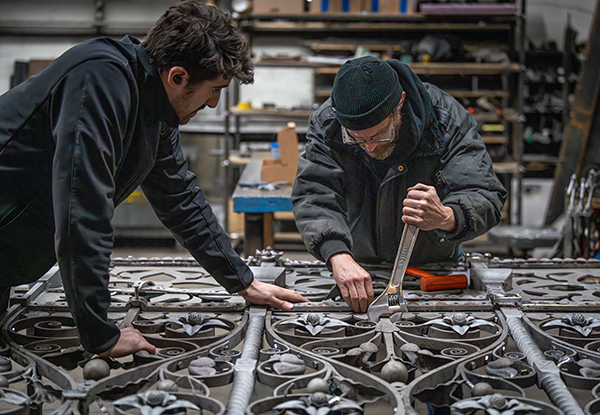
To begin the restoration, Dominion’s team stripped the outer layer of corrosion and old paint coatings. Next, the parts were soaked in a phosphoric acid bath to transform any hidden rust into iron phosphate that could be brushed away.
Each gate was then reassembled, coated with a zinc primer, wiped with a thinner to protect the newly cleaned iron and prevent rust, and repainted.
Reinstallation
Restored to their original splendour, the Queen’s Gates were transported back to Ottawa and reinstalled in June 2025.
Jones, who comes from generations of builders, said it was an “honour” to restore what he considers Canada’s most important heritage iron asset, and he’s proud of the work his team delivered.
“I feel you have to pay homage to the piece and to the artisans,” Jones said. “As hard as we worked on it, back then, they didn’t have half the tools we have. The gates were all handmade, done at a fire, at a forge, with a hammer and an anvil.”
This article was published on SenCA+, the Senate of Canada’s digital magazine, on September 8, 2025.
In February 2019, the Senate moved to the Senate of Canada Building, a former train station built in 1912. The Senate will occupy this temporary location while Parliament’s Centre Block — the Senate’s permanent home — is rehabilitated.
Although Centre Block is shuttered for rehabilitation work, Canadians can still experience its art and architecture through the Senate’s virtual tour.
link